



10 Key Questions to Ask During a Wheelchair Control Assessment
Choosing the right wheelchair control is about more than finding a system that a person can physically activate. The right control should fit the person’s abilities, goals, posture and everyday environment.
A good assessment therefore starts with the individual, not with a specific product. By asking the right questions, clinicians and assistive technology professionals can better understand which type of wheelchair control may support safe, comfortable and independent mobility.
Here are 10 key questions to consider during a wheelchair control assessment.
1. What does the person want to achieve with their wheelchair?
The first question should have nothing to do with technology. What does the person actually want to do with their wheelchair?
For one person, independent mobility may mean moving around their home without assistance. For another, it may mean going to school, working, shopping or participating in social activities. Understanding these goals provides context for the entire assessment.
A control that works well in a quiet indoor environment may not be sufficient for someone who needs to navigate busy public spaces. The person’s goals therefore help determine what level and type of control they need.
2. Can they use a standard joystick?
Before considering alternative controls, it is worth asking whether a conventional joystick could work. A standard joystick may be appropriate if the person has sufficient:
- Hand and arm movement
- Strength
- Coordination
- Range of motion
- Precision
- Endurance
Sometimes a change in seating position, joystick position or configuration can make a significant difference.
If a standard joystick remains practical and reliable, there may be no need for a more complex alternative. If it does not, however, the assessment can move on to other possibilities.
3. Which movements can they control reliably?
When a standard joystick is not suitable, the next question is: what movement does the person control best?
This means looking beyond the hands and arms. Depending on the individual, useful voluntary movement may be available through the:
- Head
- Chin or mouth
- Feet
- Fingers
- Shoulders
- Other parts of the body
The most useful movement is not necessarily the strongest or largest movement. What matters is whether the person can perform it consistently and intentionally.
Alternative drive control assessments therefore consider factors such as motor control, range of motion, strength and the presence of involuntary movements or abnormal muscle tone. (Sunrise Medical)
4. How much strength, range and precision do they have?
Being able to perform a movement once does not necessarily mean that it can be used effectively to control a wheelchair. A proper assessment should consider three related factors:
- Strength: Can the person generate enough force to activate the control?
- Range: Can they move far enough in the required directions?
- Precision: Can they make small and controlled movements?
These factors become particularly important when the person needs to manoeuvre in tight spaces or make small corrections while driving.
It is also important to assess these abilities in the person’s normal seated position, rather than only during a general physical examination.
5. How does positioning affect their control?
Wheelchair control and seating position are closely connected. A person’s ability to control a head, foot or hand-operated interface can change significantly depending on their posture and level of support. Consider:
- Is the pelvis stable?
- Is the trunk adequately supported?
- Is the head positioned comfortably?
- Can the person maintain their position while driving?
- Does changing the seating position affect their access to the control?
Positioning should therefore be considered before concluding that a particular control is unsuitable. In some cases, improving positioning can make an otherwise difficult movement more functional.
6. How do fatigue or changing muscle tone affect their performance?
A person may demonstrate good control for a few minutes and struggle later in the day.
Fatigue, changes in muscle tone, tremor or involuntary movements can all influence wheelchair control. These factors can also vary depending on the person’s condition and environment. This is particularly important for people with neurological conditions.
The assessment should therefore consider not only whether a person can perform a movement, but whether they can perform it consistently and comfortably over the period they are likely to use the wheelchair.
If control deteriorates significantly with fatigue, this may influence the type of control or configuration that is appropriate.
7. Which type of control matches their abilities?
Only after understanding the person’s movement abilities should different control options be considered. Depending on the individual, possibilities may include:
- A standard or adapted joystick
- A mini joystick
- Switch control
- Chin or mouth control
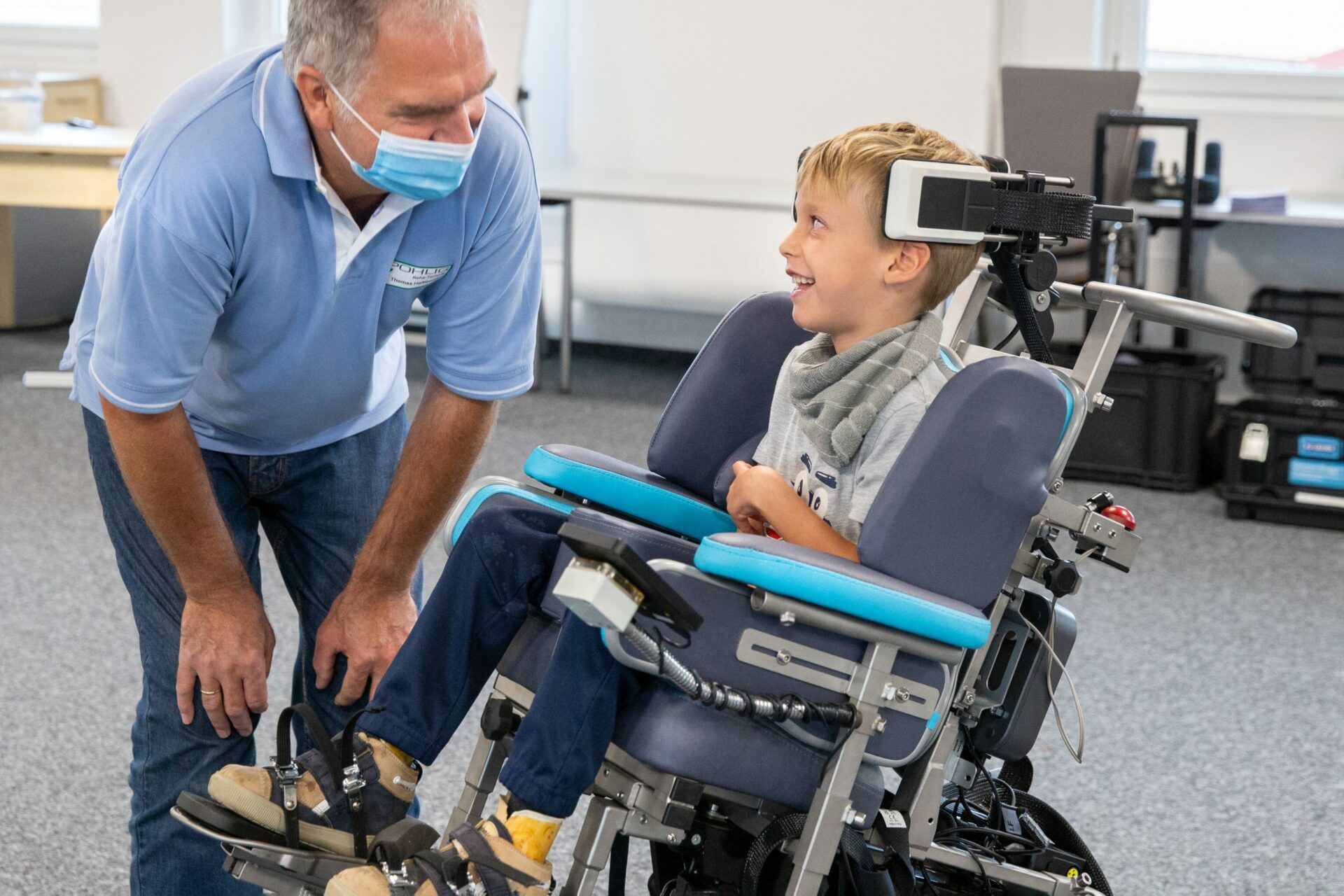
- Head control
- Foot control
- A combination of different inputs
There is no universal solution. For someone with reliable head movement but very limited arm function, head control may be appropriate. Someone else may have useful movement in their feet that can also be incorporated into their control strategy.
The goal is to find the input that provides the best balance between control, reliability, comfort and independence.
8. What other wheelchair functions need to be controlled?
Driving is only one part of powered wheelchair use. Depending on the person’s needs, they may also need independent access to functions such as:
- Tilt
- Recline
- Leg elevation
- Seat elevation
- Driving modes
- Other powered seating functions
These functions should be considered as part of the overall control assessment.
A person may have a suitable way to drive the wheelchair but still depend on someone else to adjust their seating position. For some users, independent access to these functions can be an important part of overall autonomy.
9. Can they use the control in real-life situations?
A control that works in a quiet therapy room may not perform the same way in everyday life. Whenever possible, the assessment should include situations that reflect where the person will actually use their wheelchair. For example:
- Moving through narrow doorways
- Turning around furniture
- Reversing
- Approaching a table
- Navigating around other people
- Driving outdoors
- Making small positioning adjustments
These situations provide information that a simple forward-and-backward driving test cannot.
The key question is not simply “Can this person drive the wheelchair?” It is:
“Can this person use the wheelchair effectively in the situations that matter to them?”
10. Will the solution continue to meet their needs in the future?
The final question is about looking ahead.
A person’s abilities may change over time. This can be particularly relevant for people with progressive neurological conditions, but changes can occur for many different reasons. Consider:
- Are their motor abilities likely to change?
- Could their seating needs change?
- Can the control be adjusted as their abilities change?
- Could another access method become more appropriate in the future?
Thinking about future needs can help avoid choosing a solution that only works for the person’s current situation.
The aim is not to predict exactly what will happen, but to consider whether the chosen system offers enough flexibility to adapt.
Putting the answers together
A wheelchair control assessment is ultimately about connecting several pieces of information. You need to understand:
- What does the person want to do?
- What movements can they control?
- How reliably can they control them?
- What happens when they become tired?
- How does their positioning affect their movement?
- And can they use the control in their everyday environment?
Only then can the different control options be meaningfully compared.
The process is therefore less about finding the best wheelchair control and more about finding the right match between the person and the technology.
Supporting individual mobility
At CoMoveIT, this individual approach is particularly relevant for people who need alternative control methods because conventional arm- and hand-based controls are not suitable.
CoMoveIT develops solutions including CoMoveIT Flex, which offers head and optional foot control, and CoMoveIT Drive, which provides head-only control. The appropriate solution depends on the individual’s abilities and needs.
Ultimately, the technology is only one part of the assessment. The most successful wheelchair control is the one that allows the person to use their available abilities effectively, giving them the control, comfort and independence they need to participate in everyday life.
Want to see CoMoveIT in action?
Book a free trial or find a CoMoveIT partner near you.