

For many people, gaming is simply part of everyday life. It can be a way to relax after a long day, connect with friends, compete, explore virtual worlds or spend time with family.
For people with neuromotor disabilities, however, joining in is not always that simple.
A game may be perfectly accessible from a cognitive perspective, yet the controller can make it impossible to play. Buttons may require precise finger movements, several controls may need to be used at the same time, or fast reactions may be expected from someone whose movements are limited or inconsistent.
In other words, the barrier may not be the game itself, but the way the person is expected to interact with it.
And that matters, because gaming is about much more than entertainment.
Gaming is a way of taking part
Gaming can create opportunities for leisure, social interaction, cognitive engagement and a sense of independence. For people with neuromotor disabilities, these opportunities can be particularly meaningful when physical limitations already restrict access to other activities.
Research involving families of children with neuromotor disabilities found that technology-based play was among the activities that strongly engaged children. Parents also reported perceived benefits related to cognitive and motor development and social inclusion. Notably, many children who usually played alone preferred playing with friends or family.
This illustrates something important: access to gaming is not only about being able to operate a controller. It can be about being able to participate with other people.
That becomes even clearer in research involving people with spinal cord injury. Participants described online gaming as a way to socialise, compete and connect with others in an environment where their physical disability could be less restrictive. Research involving people with motor neuron disease has similarly highlighted enjoyment, social connection, autonomy and relief from boredom as meaningful aspects of gaming.
For someone who has limited opportunities to participate in physical or social activities, being able to join friends in a digital environment can therefore have real value.
But the controller can become the barrier
Mainstream games are generally designed around assumptions about how a player interacts with technology.
Press a button quickly. Move two joysticks simultaneously. Hold a trigger while performing another action. React within a certain amount of time.
For many players, these interactions are automatic.
For someone with a neuromotor disability, they may not be.
A systematic review of 162 publications on game accessibility found that research has often focused on rehabilitation, education and health-related applications rather than gaming as leisure. The review also highlighted the continuing need to address accessibility for players with disabilities.
The barriers can be physical, technological and financial. Controllers may require movements that are difficult or impossible to perform. Buttons may be out of reach. Multiple inputs may need to be coordinated quickly. And standard interfaces are rarely designed around an individual’s specific movement pattern.
This can create a frustrating situation:
The person may have the interest, motivation and ability to play, but not the physical access required by the standard controller.
Alternative input can change that equation.
Depending on the individual, this might mean switches, eye tracking, adapted controllers, head control or another form of accessible input.
The right solution starts with the person
There is no single gaming interface that works for everyone with a neuromotor disability.
Two people with the same diagnosis may have completely different movement abilities, positioning needs and levels of control. Conversely, people with very different diagnoses may have similar functional abilities and therefore benefit from similar forms of access.
This is why the starting point should be the person rather than the diagnosis.
What movements can they produce reliably? How consistent are those movements? How does positioning affect their control? Do involuntary movements interfere with input? How does fatigue affect performance? What type of games do they actually want to play?
And perhaps most importantly:
What would this person like to be able to do?
These questions fit within the broader ICF perspective, where functioning is understood through the interaction between the person, their activities and their environment. An assistive technology can become a facilitator when it matches those factors, but can just as easily become another barrier when it does not.
Gaming does not have to be therapy
Gaming is sometimes introduced in healthcare primarily because it can be used to practise a particular skill.
There is evidence that gaming and serious games can support areas such as attention, executive function, motivation and engagement in some neurological populations. Research in cerebral palsy, for example, has explored gaming environments for interaction, navigation, target selection and cause-and-effect learning.
But this should not lead us to view every game through a therapeutic lens.
Gaming does not need to improve motor function to be worthwhile.
It can simply be something a person wants to do.
That distinction is important. Leisure, enjoyment and social participation are meaningful parts of everyday life in their own right. Assistive technology should therefore not only help someone complete essential activities, but also help create access to the activities they value.
And this is where mobility and gaming can unexpectedly come together.
Where alternative wheelchair control can fit
For some wheelchair users, the movements used to control their powered wheelchair can also provide a potential pathway into other digital activities.
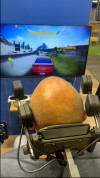
CoMoveIT FLEX is a modular head- and foot-control system for powered wheelchairs. Its sensors can be configured and positioned according to the individual’s movement abilities, and FLEX can connect directly to adaptive gaming controllers such as the Xbox Adaptive Controller.
This creates an opportunity to think beyond mobility alone.
The same alternative input approach that enables a person to control their wheelchair can, where appropriate, also support access to gaming and other digital environments.
The goal is not to turn every wheelchair user into a gamer.
It is to make sure that gaming remains an option for people who want to participate.
From mobility to participation
This is ultimately why accessible gaming deserves a place in conversations about assistive technology.
A wheelchair control system is often discussed in terms of driving: moving forward, turning, stopping and navigating an environment.
But independence does not end when someone reaches their destination.
What happens when they get there?
Can they join their friends? Explore an activity? Use a computer? Play a game with their family? Choose how they spend their free time?
These questions shift the focus from what the technology controls to what the person can participate in.
The evidence around gaming for people with neuromotor disabilities is still developing, and more research is needed to understand the long-term effects of accessible mainstream gaming. But the broader principle is clear: when someone wants to participate, the physical interface should not automatically be the reason they cannot.
Key takeaway
Gaming can offer people with neuromotor disabilities opportunities for enjoyment, social connection, cognitive engagement and meaningful participation.
Yet conventional gaming interfaces can create significant physical barriers.
Individualised alternative access can help bridge that gap, starting not with a diagnosis or a particular device, but with the person’s abilities, preferences and goals.
For clinicians, this means gaming can be considered alongside other meaningful activities when assessing mobility and assistive technology needs.
And for wheelchair users, it can mean something much simpler:
having the possibility to play.
Explore accessible control with CoMoveIT
Interested in exploring how alternative control could support gaming and digital participation?
Discover CoMoveIT FLEX or request a test with our clinical mobility team.